
ANOTHER LOST ART?
Critical thinking as creative fuel

I don’t know why this particular subject is on my mind right now. Nevertheless, it is. Maybe I’m in a “Crash Comments”-kinda mood (deep cut, there). I don’t mean to be a downer, though. Maybe we can view this through the lens of celebration, even if it is a little on the grim side…
Because some folks might say that the comicbook -- I’m talking exclusively about the “mainstream”, American version/format here, the typical Marvel/DC-style comicbook I grew up reading -- is a slowly dying art form in our current culture, in terms of its significance and influence (being an IP farm for other media doesn’t count, btw). I really hope that’s not the case, but who can say for sure? It can definitely feel that way, sometimes.
But an art form that, as far as I’m concerned, is practically dead on its feet already… is the art of comicbook criticism. By that, I’m talking about thoughtful, insightful analysis of comicbooks as they are released, so that’s part of the conversation that surrounds a particular work in the cultural moment it exists within.
Now, before someone jumps straight up my ass about this… yes, I know critical writing and think pieces about certain comicbooks (and comicbook-related material) do crop up from time to time. But nothing like they did twenty, thirty, forty years ago. Plus, these are often more literary-minded works being discussed, not material in the Marvel/DC space. And certainly nowhere that’s accessible to a larger audience.
Anyway, I was thinking about this in relation to filmmaker, Quentin Tarantino (one of my absolute favorites for the past thirty-one years) and famed film critic, the late Pauline Kael. Specifically, how one of Kael’s reviews affected -- and ultimately influenced -- a young Tarantino’s early filmmaking aesthetic to an intense degree.
One of many collections of Kael’s writings -- Kiss Kiss Bang Bang, first published in 1970 -- contains her review of Jean-Luc Godard’s French New Wave (or Nouvelle Vague) film, Band of Outsiders (its more famous French title being Bande à part), apparently released in American cinemas for exactly one week in 1966. As recounted by Tarantino himself in a video interview for the original Reservoir Dogs DVD release, when he first read the following passage, he realized that what he wanted to achieve in his own work had been succinctly crystalized by Kael in her writing. Quoted from the review…
“It’s as if a French poet took a banal American crime novel and told it to us in terms of the romance and beauty he read between the lines; that is to say, Godard gives it his imagination, re-creating the gangsters and the moll with his world of associations -- seeing them as people in a Paris café, mixing them with Rimbaud, Kafka, Alice in Wonderland.”
Pretty spot on, if you ask me. At least when it came to Tarantino’s first few films.
It made me wonder if there was any piece of “old school” comicbook criticism that similarly influenced my burgeoning aesthetic when I was just a young punk, often daydreaming about someday becoming a professional comicbook writer… something that purposefully stated outright what I wanted to go for in my own work.
Turns out, there was.
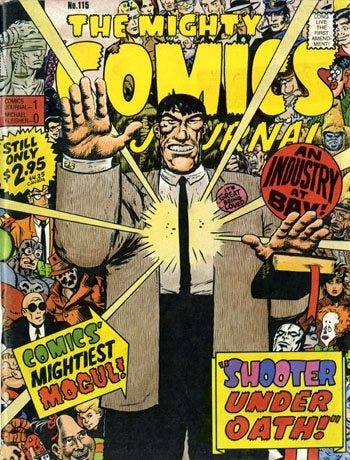
It was in The Comics Journal #115, released in April 1987. Specifically, it was then-critic, Rob Rodi’s review of The World of Ginger Fox graphic novel by Mike Baron and Mitch O’Connell (originally published by First Comics). Baron was arguably my favorite comicbook writer of the 1980’s, so whenever his work was put under the microscope by good critics, applying measured, critical thinking, I always paid close attention.
The review itself was a bit of a takedown, but this general description of Baron’s work caught my attention at that time...
“For him (Baron), comic books have an inherently loopy surreality [sic] that tends to throw all serious intentions into sort of garish, Mack-truck relief. He glories in the kind of goofball, seat-of-your-pants sensitivity that, paradoxically, makes his work seem almost enlightened, as if he’s beyond all this ‘comics-as-art’ lip-flapping and just wants to have sort of a high-profile gas. He’s going to be an awfully good arbiter of our present culture, I think, for future sociologists.”
Much like what the Pauline Kael excerpt did for Tarantino, Rodi’s description of Mike Baron’s writing style -- and his perceived intentions -- made a definite impression on me at the time. It gave me something to shoot for when it came to formulating my own sense of the type of comicbook writer I wanted to be one day and the aesthetics I was interested in exploring. And even as I went many years without Rodi’s appraisal at the forefront of my mind, I realize in hindsight that it was still what I was aspiring to achieve. It was still buried in my brain like some kind of virus… infecting me… subconsciously influencing me... pushing me forward…
(Incidentally, Rodi himself went on to become an accomplished writer in his own right, including penning several comicbooks. Good writing is good writing.)
That’s what effective critical writing can do for those of us lucky enough to read it at the right time. It can be incredibly inspiring. Which means that it has an important place in the greater macrocosm of comicbook culture. Without it, there’s definitely a vacuum left behind. Personally, I feel it. And I miss it.
Now that print journalism is effectively dead… now that we’ve moved beyond general blog culture on the internet and have fully embraced more bite-sized content (hooray for short attention spans!)… I feel like the places where healthy, expansive, accessible comicbook criticism can even exist -- let alone thrive -- are few and far between. Even the critical writers who can clearly turn a phrase seem to have found themselves with nowhere to fully express themselves. And when they do, they’re undoubtedly doing it for themselves, not for the eyeballs of a dependable, wider readership.
(Yes, I’m well aware that The Comics Journal still has a website that contains plenty of reviews… but much like the magazine did in the early 2000’s, it leans more toward either the literary side of comicbooks… or the alternative side. Both are valuable, but is TCJ.com a true destination site for anyone in great numbers?)
That brings us to the comicbook space currently found on YouTube, which certainly provides an adequate opportunity for more thoughtful, expanded criticism (at least ten minutes’ worth, on average). While those who toil in those fields can be personally engaging and often fun to watch, your average YouTube host isn’t typically an experienced writer. Technically, they’re broadcasters. As such, they’re getting better all the time, more and more polished in their presentation. But I haven’t seen a ton of quotable eloquence or even the occasional biting turn of phrase in the actual writing found in these videos (assuming that at least some of these YouTubers are writing their scripts for broadcast beforehand). Not yet, anyway.
And just to point the finger at myself for a second, I guess a real cynic could make an argument that the work currently offered up by the “mainstream” publishers isn’t particularly worthy of deep, critical consideration. But I’m not that cynical. Not yet, anyway.
On the other hand, where is our Pauline Kael right now? Where is our Lester Bangs? Where is our Roger Ebert? Don’t we deserve the kind of critical thought -- and critical writing -- that will, in its own way, help propel the work itself to greater levels of insight for those of us who truly appreciate it? We had it once. Can’t we have it again?
It’s really not about selling comicbooks. It’s not necessarily about promotion, because it’s certainly not about achieving more widespread, pop cultural acceptance. We know how that goes, don’t we? In fact, it’s about the exact opposite. It’s about establishing (or possibly re-establishing) our own internal standards of excellence or examining creative context at a deeper level. It’s about nurturing voices -- both creative and critical -- to help strengthen the greater comicbook community and take us into the future.
So maybe it’s true… perhaps deep-dive comicbook criticism has, in fact, become a proverbial “lost art”. Maybe not so much in form, but certainly in function. I mean, where would one even go to find it these days? If I knew that, I might be there right now…
Hey, if any of you can point me in a direction where I can find what I’ve been missing, feel free to sound off in the comments section below.
Until next time…
Joe Casey
USA
As a former/sometime member of the "comic book press," I don't have much hope for any kind of serious push forward for comics journalism as far as the written word is concerned. The once-reliable sites from the glory days of the 2000's either died out or were all bought out by larger companies to act as content farms whose only concern is pageviews and engagement, where the writers are made to write in very specific ways that are entirely designed around what will stand out best in Google search algorithms.
To be fair, the more serious, analytical pieces just don't get the numbers the way the easy clickbait/engagement farming-articles do, unless you can find a strong hook for the headline. But I feel like unless you're providing something more than just an attention-grabbing headline, you're not giving your audience much reason to check back in regularly, and merely become a part of Russian Roulette-esque news feed that sees readers randomly selecting from a collection of all the pop culture sites' coverage of the same topic.
The only real space where deeper analysis of comics is taking place (as far as I can see, anyway) is in podcasts and on YouTube, although I do agree there has been a steep learning curve for many who have been operating in those spaces. It does feel like the majority of it is reaching its own maturation over the last few years, which is exciting. As far as my favorites... Word Balloon is still the best interview podcast out there, hands down. On YouTube, Strange Brain Parts might just be the Kogonada of visual essays on comics. And while they're sadly no longer around, Cartoonist Kayfabe left behind a treasure-trove of analysis and insight that I think will be highly influential to creators for years to come.
I’d say the best criticism I’ve seen recently is actually on Substack, often done by creators themselves. While the motivation might be more just to fill the content void to build the creator’s profile through steady release, the results are often revelatory. These are usually less straight critique and more celebratory posts about an artist, page or even panel that excited the writer. The focus of these pieces is less cultural and more craft focussed.
Aubrey Sitterson (writer of Free Planet) was dropping two to three of these a week as a build up to the premiere of his own series. His pieces highlighted both mainstream and indie books, often using inspiration gleaned from the work as jumping off points to talk about the form with an emphasis on where the craft of comics could go. I would love to see more of this kind of writing channeled into print.