
POST MORTEM - PART ONE
The things we learn in hindsight

It’s finally time to talk about it… to really get into it… to answer that burning question that’s dancing on everyone’s lips: “What the hell happened with WEAPON X-MEN?”
First things first…
Fair Warning #1: These next two newsletters are going to get a bit “inside baseball”, in so far as the comicbook industry is concerned. So, if you’re into that, sit back and enjoy. If you’re not sure, just please bear with me…
Fair Warning #2: There’s going to be a bit of nuance involved in this autopsy. If anyone has a problem with nuance -- and recent history proves that there’s a decent percentage of people that do -- then these two newsletters may be a little difficult to digest.
Fair Warning #3: There are no blockbuster, break-the-internet revelations contained herein. ‘Nuff said.
So the party line -- in what we often laughingly refer to as the current “comicbook press” -- is that our series was “cancelled” after five issues. Look, I get it. It’s an easy headline. But it’s simply not the truth.
As far as I’m concerned, the term “cancelled” doesn’t even really apply to this situation.
Let’s get this straight, too… this is not about pointing fingers. If that were the case, I’d have to start by pointing a finger directly back at myself. And I’m sure as hell not in the mood to do that…!
I think you can just file this one under “SHIT HAPPENS”. No one is at fault. Everyone is at fault. Take your pick. Blah, blah, blah. This is just how it goes sometimes in this business.
Before we go any further, if you want some additional backstory on the series (and the bizarre comedy of errors that took place during its development), check out these previous newsletters…
… okay, so hopefully we’re all caught up now. But it’s an age-old story, really. New idea pitched. Editorial turnover. Name gets lifted. New idea finally gets greenlit. Slight marketing confusion. Series debuts. Ends with issue #5. Now, let’s go a little deeper…
From the “New idea pitched” category: once I’d thought of it, I quickly boiled it down to a simple one-sheet that succinctly presented the concept, the characters and the title (and, as you can see, even the logo)...
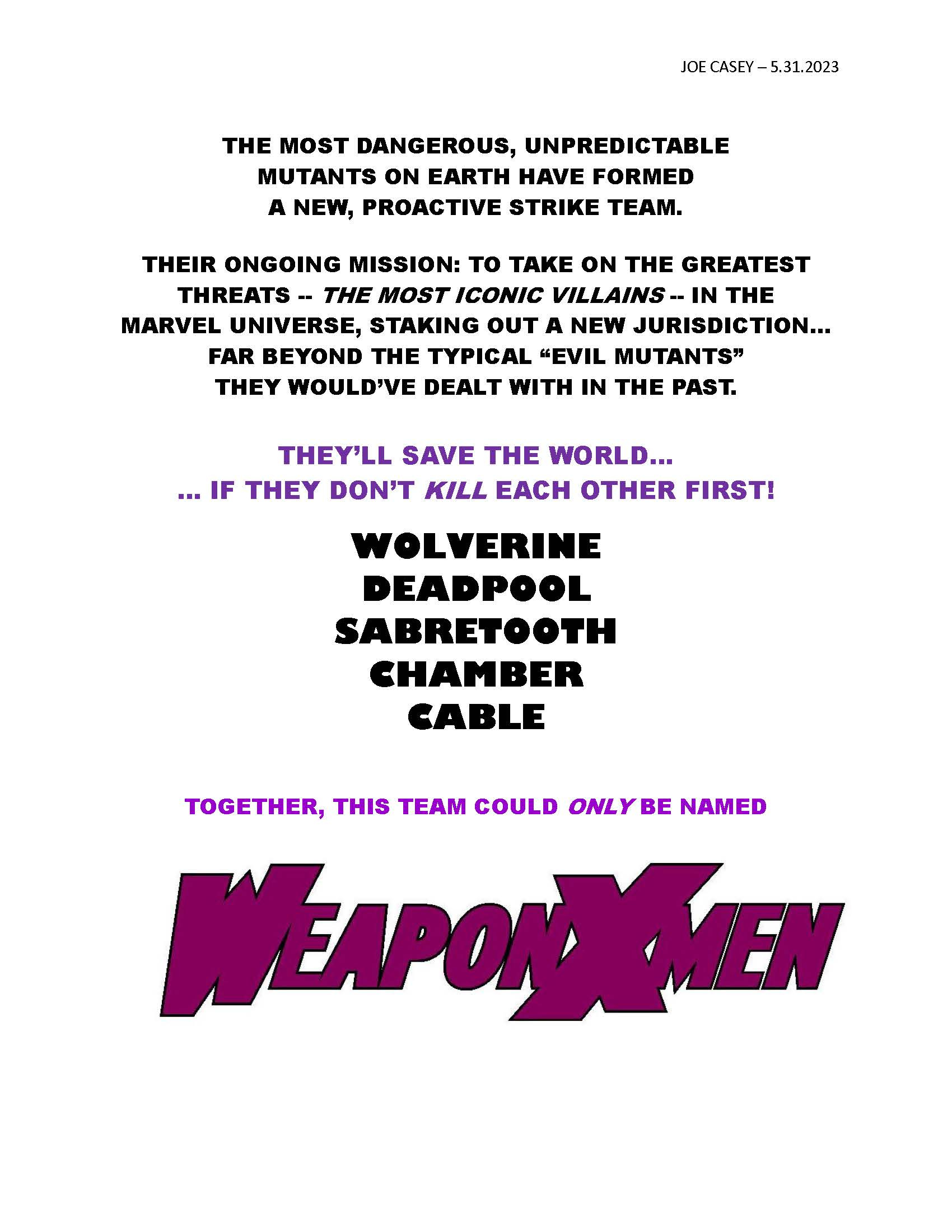
… now, you’ll notice I didn’t specify whether this was being pitched as an ongoing monthly or as a finite mini-series. I fully intended it to be an ongoing, but this initial document was only meant to get an editor pregnant with the basic idea.
But that innocent omission on my part would end up being a significant factor later.
WEAPON X-MEN had a simple premise for me, personally… to do an X-Men series in the vein of an Avengers series. In fact, as it developed, I found that I was following the original Avengers template almost perfectly. That being the teaming up of three “A-list” characters (Iron Man, Thor, Hulk) with a pair of “C-list” characters (Ant-Man and the Wasp). For WEAPON X-MEN, the three A-listers were obviously Wolverine, Deadpool and Cable, with the C-listers being Chamber and Thunderbird). It was as commercial an idea as I’d ever come up in a corporate, work-for-hire situation. A proverbial no-brainer.
It seemed as though Marvel editorial agreed. On either side of the editorial shakeup that occurred at that time, there was definite interest in WEAPON X-MEN. Even after the “name theft”, the project moved forward. Because the next thing I heard was that it had been pushed up the chain and was now in the hands of “P & L”.
What is “P & L”, you might ask? And how does it relate to comicbooks getting published?
At Marvel, it works something like this: when a new project is being developed -- either pitched by an editor or, in this case, pitched by a creator and shepherded by an editor -- it inevitably goes through a formal P & L (which stands for Profit and Loss) process. That process involves estimating the project’s sales potential, which is then weighed against what it’ll cost to actually publish said project. If the margin as calculated is determined to be a net positive (financially speaking), then editorial is approved to move forward with the creatives to actually make the book and eventually get it out into readers’ hot, sweaty hands.
Not being inside the Marvel offices, I can only guess that this P & L process involves accountant types of some kind. I can also only speculate on the specific metrics used for this particular process, especially when it comes to corporate-owned comicbooks. But I would assume it takes into account such varied factors as 1) name recognition and sales history of the character(s) involved, 2) the creative elements involved (including their sales track records and/or their potential value in the marketplace), what those creative elements will cost the company (in the case of comicbooks, we’re talking about page rates or whatever contractual obligations already exist), and 4) the sales history of similar projects (if, in fact, those even exist). Whatever info is available -- and I’m talking about cold, hard facts exclusively -- is taken into consideration. It all seems very cut and dried. Because I sincerely doubt the process involves any kind of “gut reaction” to the material being evaluated. Having an inherent sense of whether or not something is -- or will be -- objectively “good” is probably not something that accountants think about. Accountants are about hard numbers. I doubt they ever get to speculate based on taste or intuition. That’s not in their job description.
And, believe me, this isn’t me knocking accountants (or accountant types). Not at all. Within a corporation, they’re a necessary component. After all, corporations exist primarily -- if not exclusively -- to make money, right? And somebody’s got to keep track of those finances. Otherwise, a corporation cannot succeed.
Another part of that P & L process is predicting sales curves. By knowing the marketplace, taking into consideration all the elements and the data involved, it’s possible to predict exactly how much a series will sell from issue #1 onward. These days, it’s almost too easy… since the current marketplace is so dangerously soft (and, in its way, an easy system to game). Why else would publishers come up with schemes like multiple covers, retailer variants, order incentives and blind bags in order to achieve the kind of sales numbers that, in the past, could -- more often than not -- be the result of content quality? So, yeah… we’re fully in the era of publishers gaming the system. But even with all those tricks at their disposal, the typical sales curve over the course of any series almost always trends downward.
Marvel, in particular, has been somewhat public about what it thinks it can sell. Publisher Dan Buckley (who I don’t know personally) even did an interview a few years ago where he stated that new, ongoing series at Marvel would at least get ten issues of runway in order to prove themselves.
Well, c’mon, he didn’t just pull that number out of a hat. That ten-issue number is undoubtedly based on internal market research (gathered over years, I’d imagine) that has definitively proved that, past issue #10, a series trending downward is no longer financially feasible to publish (often a series trending downward could be losing money well before it hits issue #10, but Marvel seems willing to give most of their books at least that much rope. At the moment, anyway).
The same goes for finite series being five issues in length. Back in the day, a “mini-series” (as they’re generally known) was usually four issues. Then it got bumped up to six issues (probably to make the eventual trade paperback edition work at its established price point). Now it’s five issues. Why? Because the typical downward trend of finite series has proven -- to Marvel, anyway -- that publishing any more than five issues would not turn a profit, and therefore would be financially irresponsible.
Again, it’s all very cut and dried. It’s about putting systems in place that such decisions are made practically on autopilot.
So how does all of this relate to WEAPON X-MEN…?
Come back for the next newsletter and I’ll explain how.
Joe Casey
USA
Fascinating. I greatly enjoyed the series and was saddened by its end. Looking forward to part 2.
I’m confused re the timeline, editorial change and co-opting of the title. In other words, did Joe pitch the book to Jordan White’s office when White was running the X-books; the other Weapon X-Men was then published; the Brevoort gets the X-line including Joe’s pitch?
As for five issue miniseries: I’ve seen nothing but what I suss is that five issues with a larger first issue is enough for a trade *and* saves on the trade by having one staple fewer (or whatever they call the sheet of paper that when folded in the printing process becomes however many pages (16 IIRC)).