
POST MORTEM - PART TWO
More things we learn in hindsight

Welcome back. Hopefully, you’ve all read the previous newsletter, which contained Part One of this corporate comicbook autopsy. Scintillating stuff for some of you, I know. But let’s press on…
The whole “what happened?” comes down to this: No one ever checked with me whether or not WEAPON X-MEN was intended as an ongoing or as a mini-series. It was later related to me that there was an assumption that, because my company, Man Of Action Entertainment, does quite a bit of work in TV animation (along with the occasional live action project) that I would not have the time to dedicate to an ongoing series. Now, that's simply not true... but I didn't make that clear from the outset.
So as far as the P & L process was concerned, WEAPON X-MEN was being pitched as a standard, finite series... which, at Marvel, means five issues. And it got approved as such.
Once that happened, I assume that certain mechanisms were almost instantaneously locked into place -- in a very corporate, well-oiled machine kind of way -- that determines the amount of resources Marvel would allocate to the production, the marketing and ultimately the selling of a standard five-issue mini-series. Those resources include number of variant covers, amount of marketing that'll be done (i.e. not much), etc.
I assume this was all settled and in place before I even got word that it was approved as a five-issue series. When I was told, I was understandably confused. For my part, I had mistakenly assumed it had been put into the P & L process as a monthly ongoing series. I’d forgotten that I hadn’t specified that. I remember thinking, "Did we only get approved for five issues because Marvel thinks this book won't sell enough to warrant more? A book starring Wolverine, Deadpool and Cable?" I mean, Dan Buckley had already made his public statements about new monthly ongoings getting at least ten issues to give them a shot at finding an audience that could sustain them, long term. Why didn't WEAPON X-MEN -- a pretty commercial idea, imho -- get that same consideration?
Because within Marvel, it was never considered an ongoing in the first place. So, as far as I was concerned, its fate was pretty much preordained.
Y’see, it’s fairly common knowledge that mini-series -- that aren’t major event series -- are not ordered by retailers in particularly high numbers. I mean, let’s be real, seeing that “1 (of 5)” in a solicitation is, to a great degree, the kiss of death (although, some of these finite series can live on -- and find some measure of success -- in collected edition form, but even that is becoming more and more rare).
I expressed this concern to editor Tom Brevoort and we both agreed to do our best to ensure that the “(of 5)” didn’t get out publicly, even to retailers. We were somewhat successful, but not completely. Some distribution outlets were made aware of the “(of 5)” of it all and dutifully included it with their solicitation information. The result was a mixed message. Readers and retailers were confused. In public, both Tom and I held our own party line that WEAPON X-MEN was intended to be an ongoing series, both of us knowing that if the series had any chance of getting an issue #6 and beyond was dependent upon orders on the first five issues being huge.
But, of course, that was never going to happen…
Obviously if a series sells like absolute gangbusters (pun intended), Marvel -- or any publisher -- will find a way to keep doing it. However, the resources allocated to a finite, five-issue series -- in the marketplace in which we currently operate -- practically guarantees that the book will not sell above a certain level, and thus, make it impossible to ever achieve the level of sales success necessary to even consider shifting it to an ongoing status. It’s an unfortunate, self-fulfilling prophecy.
To put it another way... let's make a hypothetical comparison: “Project A” (approved via the P & L process as an ongoing series) launches with, I dunno, 15 variant covers (including a marquee name cover artist like, say, Frank Miller), significant retailer order incentive programs, a major marketing push, pre-planned new printings of engineered “sell outs” and countless other methods in which you can raise awareness and, ultimately, pump up order numbers to ensure success at a certain level.
“Project B”, on the other hand, has been approved by P & L as a five-issue mini-series. Its first issue only gets, say, four variant covers, no retailer order incentives (beyond the standard, offered on almost any new series, no matter what the format) and very little marketing beyond the bare minimum.
Which project do you think is going to sell more?
And, like I’ve said a few times already… it’s really a tough market right now (don’t let the reported “healthy” sales numbers fool you, a lot of those higher numbers are due to the publisher tricks I laid out earlier). So we all do what we think is best to get by. That’s why I suggested we recruit Alex Ross to paint an absolutely killer first issue cover. It might’ve skewed the financials that had been earmarked for the book at that time, but I still think the result speaks for itself…
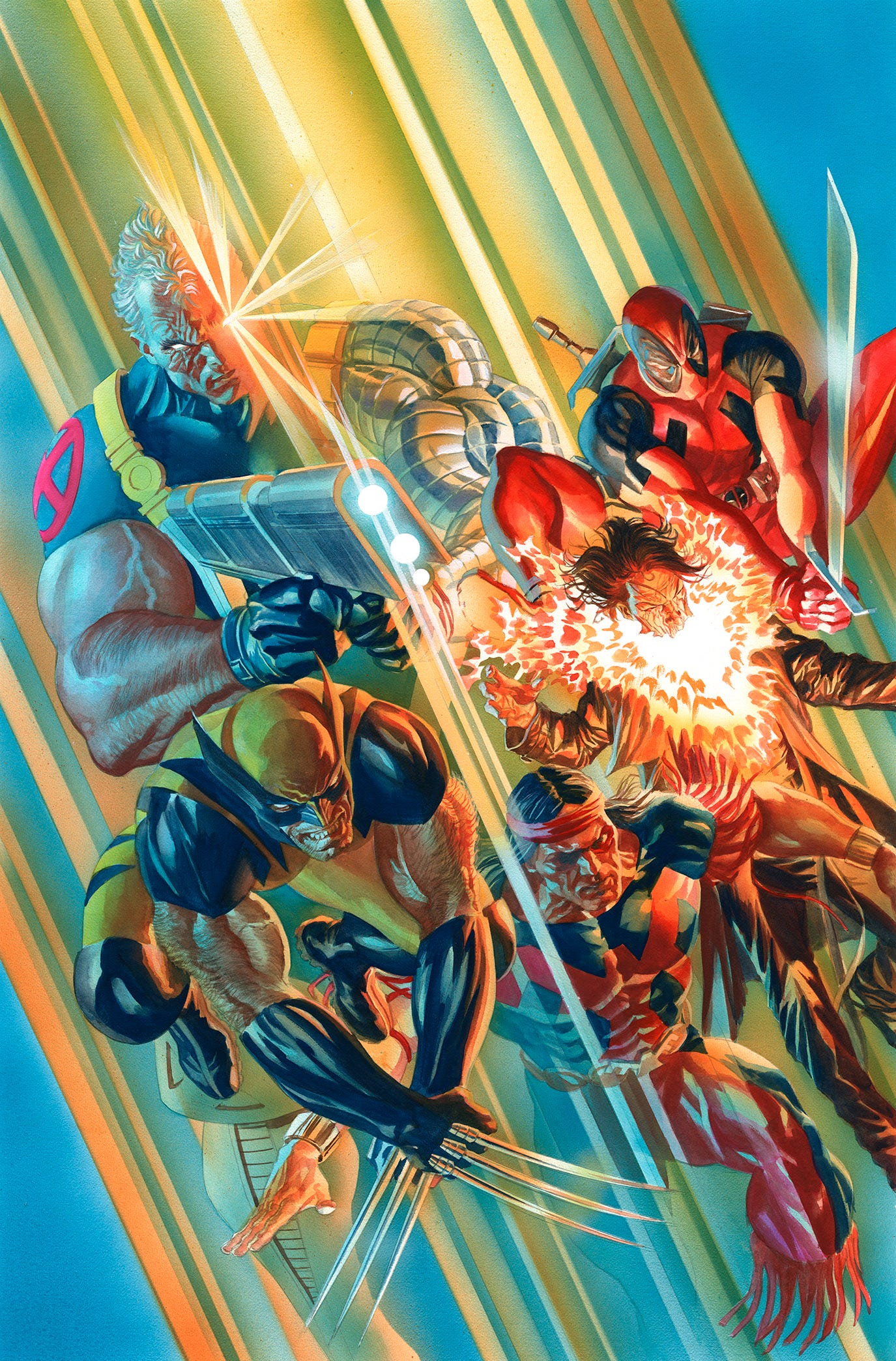
Another swing that was taken to try and goose the situation: Between the announcement of the series and the final solicitation for issue #1, an editorial decision -- fully intended to help give the series a bit more top spin in its launch -- resulted in a banner on the first issue cover that branded WEAPON X-MEN (the first issue, at least) as part of the big Marvel publishing event that was a fairly big push for the first half of 2025. It was certainly worth a shot. Unfortunately, from what I saw, this ended up causing a bit more confusion. At least, on the readers’ part. For retailers, based on the information they’d been given, I think they now knew exactly how to order the book.
There were several other event tie-in series -- most of them finite -- that launched the very same month as WEAPON X-MEN. And from looking at the limited sales data available these days, our book debuted near the top of the list of those other tie-in series (which were all ordered in fairly similar numbers across the board). Its order numbers were probably what you would most likely predict -- and ultimately expect -- for similar tie-in series that sported that same event banner. Good, but certainly not great. Not “blockbuster” numbers, by any stretch.
When WEAPON X-MEN was finally released in stores, the reader reaction was pretty much what you’d expect. Over the five months of its release, some liked it, some didn’t. Some readers got what we were doing, others didn’t. Completely expected, especially when it comes to an X-book (believe me, I’ve been here before). In fact, I might’ve been a bit of an outlier on this one, because there was probably a time -- not too long ago -- when the metrics on this series would’ve been much more favorable. I mean, I thought it was still commercial as hell. But, to put it bluntly, it had quite a few things stacked against it.
Ultimately, I tend to look at these things philosophically. On the one hand, it’d have been nice to continue the series for a good, long run. I had plenty of ideas for where to take things next, but unfortunately a lot of those ideas will probably never see the light of day. It’s a bummer, sure, but that’s just how it tends to go in a work-for-hire situation.
On the other hand, I was afforded an enormous amount of creative freedom on WEAPON X-MEN, much more so than you might typically imagine on a corporate gig involving such high-profile, franchise characters. In fact, the five issues that were released are -- with a few minor, par-for-the-course exceptions -- exactly what I wanted them to be (for better or worse). I was very lucky, in that I was allowed to execute my vision -- as a cult-level comicbook writer -- my way. Not a bad way to make a buck, if you ask me.
Sometimes these situations can feel a little like you’re expending your breath to inflate a balloon that’s suffering a slow leak, one that may never be fixed… but I’ve never been short of breath when it comes to doing the work that I love.
Okay, so there you go. I could probably go on and on when it comes to this particular subject, but I’ll show you guys a little mercy here. Needless to say, lessons were learned… but some fun was had, too.
Next week, we’re going to try something a little different. For this newsletter, at least…
Joe Casey
USA
Lots of your comments, regarding what helps sell a book, reinforce my feeling that comics are being held up by collectors not readers.
Variant covers. Issue 1s (rebooting numbers). New costumes. New identities of known heroes. New characters that you are told well in advance so you can preorder. (KEY issues as collectors say).
But nothing about stories, consistency or even art!
So given that this was a f*** up that couldn’t be corrected — P&L were what they were and binding — any possibility of the book being resurrected?
And FWIW, I find a miniseries possibly more attractive than an open run. Minis can just be better. The example at the moment maybe is “The Power Fantasy” which apparently is going have a sixteen issue run. To me, that’s a mini.